Key Survey Takeaways
What we learned from surveying 144 parents and how it helped shape our product.
5ee389c 7 min readWe surveyed 144 parents in the EU and the UK asking them questions regarding our product and pricing. These are the three takeaways that we brought with us.
The survey was conducted using Prolific targeting 4 groups of people:
| Group | Respondents |
|---|---|
| EU, youngest child up to 12 months | 13 |
| EU, youngest child 1 to 5 years | 13 |
| UK, youngest child up to 12 months | 35 |
| UK, youngest child 1 to 5 years | 83 |
Note: "up to 12 months" also contains parents expecting. EU here is the Netherlands, Germany and Sweden.
After selection the respondents were screened out if their youngest child was older than 5 years. Post screening we collected information that helps us understand our respondents better. For us there is quite the difference between someone who has actively looked for an app that makes sharing images privately efficient and someone who just uses chat/iCloud/Facebook.
| Youngest child | Respondents |
|---|---|
| Expecting | 1 |
| 0-12 months | 47 |
| 1-2 years | 44 |
| 3-5 years | 52 |
| How they share photos of their child today (several allowed) | Respondents |
|---|---|
| WhatsApp / Signal group | 138 |
| 52 | |
| Instagram (private) | 47 |
| iCloud or Google shared album | 20 |
| A family-album app | 16 |
| Print or email | 15 |
| What they pay for today (several allowed) | Respondents |
|---|---|
| iCloud / Google storage | 85 |
| A family-album app subscription | 9 |
| A photo-book service | 9 |
| Nothing | 54 |
The problem
QuietAlbum was created with three main goals in mind.
- Privacy first. Images are not accessible through random URLs and require authorization to be accessed. No AI is trained on your images, nor is AI a part of the product.
- Ads have no place in cherished memories. Ads whether external or our own marketing will never be a part of the user interface. If we want to market something we will send an email. If you have opted out you will not receive it.
- You have every right to be forgotten. The EU has some of the strongest laws in the world regarding this. We stand by them. You can request to be forgotten anytime.
The survey showed that 91% of respondents rate "no-selling/no-analysis" as an essential part of any photo sharing product. Encrypted storage of user data was also rated high at 78%. This was the validation we needed to feel that our primary goal is shared between us and our potential customers.
When it comes to ads we were fairly surprised with only 44% of respondents agreeing that ads next to their child's photos bother them and some 36% not caring at all. The picture changes when the question is what they would choose: asked to pick between a free service with ads and a paid one with no ads and no data use, only 19% picked free with ads, 28% picked paid and 49% said it depends on the price. 65% rated "no advertising, ever" as important when choosing a service. Ads do not bother most people today, but few would choose them. Either way it does not move our goalpost the slightest. We will either exist without ads or not exist at all.
The survey never brought up deletion explicitly. The closest it came: 56% worry about where their child's photos are stored, which country and which company, and 44% rate "photos stored only in the EU" as important when choosing a service.
Overall it feels as if we are positioned correctly. We need to work on communicating the benefits of the product in a way where it is easy to grasp why we are the clear alternative to the traditional players in this field. In a sense we have a benefit of not having a bad track record but there is also the fact that since we do not have a track record we have absolutely zero trust instead. This will be an uphill battle.
The price
As a part of the survey we had some questions for a Van Westendorp analysis asking the four questions:
- At what yearly price would this be so cheap you'd doubt its quality?
- At what yearly price would it be a bargain?
- At what yearly price would it start to feel expensive, but you'd still consider it?
- At what yearly price would it be too expensive to consider?
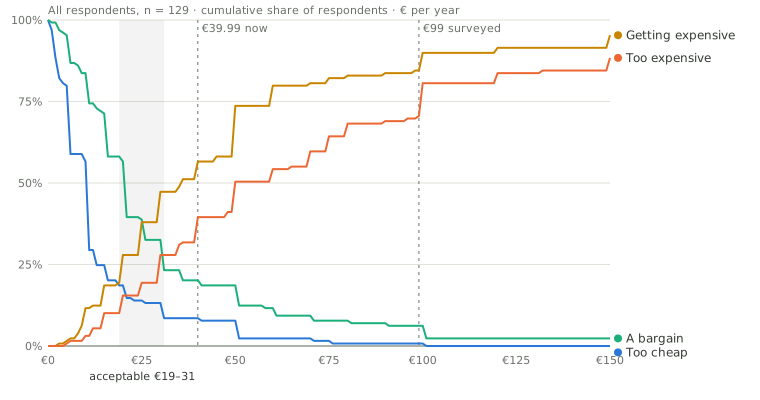
This is how they responded to this. The chart counts 129 of the 144: 15 respondents gave answers that do not climb from question 1 to 4 (a "bargain" above their "too expensive", for example) and the method drops those.
These are the points we look for:
- Too cheap crosses getting expensive: below this price people doubt the product. €19.
- A bargain crosses too expensive: above this price you lose more people than you gain. €31.
- Between the two: the acceptable price range. €19-31 per year.
- Too cheap crosses too expensive: the optimal price point. €21.
- A bargain crosses getting expensive: what people expect to pay. €25.
One caveat on the currency. The price fields had no symbol and the UK respondents, 82% of the sample, answered in pounds. The numbers above treat £1 as €1. Converting the UK answers at 1.17 moves the acceptable range to €20-36 and the expected price to €30, so the conclusions hold either way.
If we were to remove the people that do not care about ads the analysis looks slightly different.
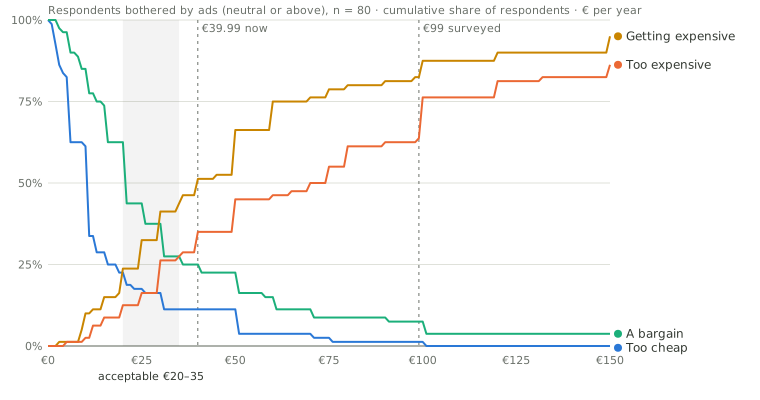
With the 52 respondents who do not mind ads next to their child's photos removed, 92 remain and the chart again drops the ladders that do not climb, so it counts 80. The acceptable range moves to €20-35, what people expect to pay to €30, and the median "too expensive" from €50 to €72.50. At €99, 64% still say too expensive; at €40, 35% (40% before the cut). The people who share our view on ads will pay a little more for it, but not twice as much.
If we put this in contrast to our competitors, at €39.99 a year we price ourselves a little under the family tier of the market leader (€54.99 a year, and it still shows ads on the free tier below it) and the yearly plans of two UK apps (€59.99 a year each). We are substantially cheaper than the largest US app (€79.99 a year, or €179.99 for the family plan) and the market leader's top tier (€104.99 a year, the only one where tagging is included). Every one of those prices is for one family, as is ours.
This is my first time performing such an analysis and I find it fairly interesting that the prices the competitors have set are so incredibly much above what we ended up with after the Van Westendorp analysis. Time will tell what happens. One thing I am fixed on is that we will never raise prices for existing customers.
The competition
At the end of the survey we described our concept and asked the respondents what they would compare it to.
| Compared to | Respondents |
|---|---|
| Google Photos | 41% |
| iCloud shared album | 31% |
| The market-leading family album app | 30% |
| None of the alternatives listed | 22% |
| The three smaller family album apps we listed (combined) | 6% |
The takeaway here is that even if we have studied family album apps for quite some time, our respondents have not. For them the alternative is the app that comes with their phone. If they want to send a picture they use chat (a reliable 96% of respondents). Only 11% of respondents use an app like ours at all. 59% already pay for cloud storage and that is the price they compare ours to.
This could affect our positioning. We don't want to be a better family album app than the ones nobody here uses. We want to be the reason someone moves the child's photos out of the chat group and out of the storage plan that was not designed for this case. What the chat group gives them is the grandparents' reactions and comments. What it does not give them is control over where the picture goes next.
What we take with us
- We need to build trust in the fact that we take privacy seriously. Nine in ten want their photos to never be analysed or sold.
- Parents will pay, but far less than the incumbents charge. We will sit at €39.99 a year (€24.99 for the first year) and will never raise the price for existing customers.
- Our competition is the chat group and the phone's own photo app, not the album apps. The pitch is the personality of a group chat without losing the control of where the image goes next.